As I’ve probably mentioned before, the Lepidoptera were my first serious interest and, from the age of 8 or 9, I filled my mind with amazing books (now very old books) on lepidopteran biology and ecology. EB Ford’s charming New Naturalist volume was particularly inspiring. It was also a profoundly depressing book, being filled will anecdote upon anecdote from the 1930s of fields literally filled with beautiful species like Fritillaries, Blues and Clouded Yellows. That was, of course, before tax-payers funded the comprehensive agricultural destruction of our countryside. By my time, in the mid 1960s, such scenes were long gone and seeing even a solitary example of such butterflies was a rare treat, mind you we had rancid butter mountains and lakes of undrinkable wine, well done chaps, good show. Another few decades and even those treats (the butterflies, not the vinegar) were gone. The same of course applies to essentially all invertebrates, they just hang on, often using so-called 'brownfield' sites in urban margins. Of course those residual refugia are now being covered with even more crammed-together gardenless houses. And that ladies and gentleman is how you wipe out nature, push it into a corner, then concrete it over. It makes one want to weep. I’ve said it before, and I’ll say it again no doubt, but thank you god for Majestic wines!

LEPIDOPTERA

Today, as a photographer, I often wonder how butterflies can be so beautiful, yet so damned irritating. In my younger years I could dance and prance, waving a butterfly net around like a dervish, over hill and dale, for hour after hour. 60 odd yrs on, and carrying a heavy camera rather than a net, not so much. So their ‘am I about to land, oh no I’ve changed my mind, let see what’s over there’ and the ‘ oh I’m so happy flying in this straight line, no I think I’ll fly this way now, oh look there’s a fence. a river, and maybe even a minefield that way’ can get a tad annoying. Of course, as often as not, when one does settle it drops down into the vegetation and you can’t see it, let alone take a picture. Still, you have to love ‘em. If I ruled the world (that's a serious offer bye the way) there'd be a lot lot more of them about

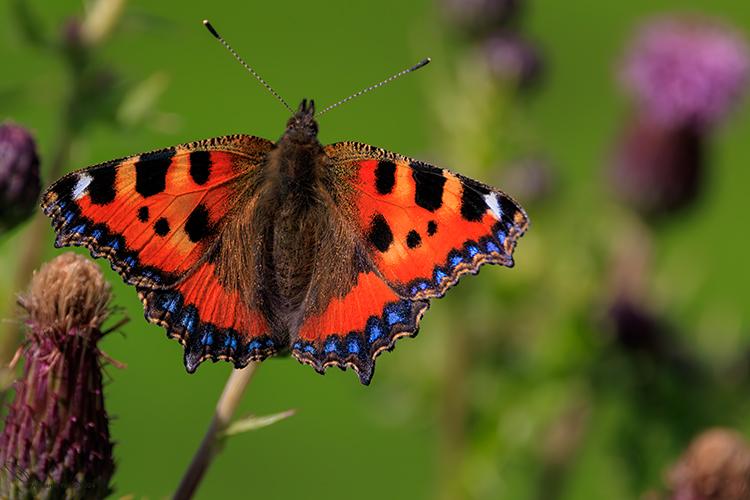
Aglias urticae:   morning fresh

Common (as much as any butterfly is today) but still beautiful, and this specimen is newly emerged with fresh rich colours. Soon those delicate wings will sustain damage, even notches from bird strikes, and the coloured scales will begin to rub-off. But I’ve been lucky enough to catch him on a good day, almost fresh from the pupa.

Like many Nymphalidae in the UK this species over-winters as an adult, hibernating in crevices in tree bark, under eaves and even in sheds. This is reason you often see one flapping against the glass trying to get out on sunny days in spring. Those specimens often look pale and tired (like me), but they have to mate quick and lay eggs. Please ignore idiotic crap about planting thing like Buddleia to attract butterflies. Er no if you want butterflies keep a few small patches of things nettles and other 'weed' species etc around the back of the shed or something. And why not plant native species of flowering plants rather than gross exotic foreign ‘tarts’ of flowers. Just sayin’.

Photographically this chap gave himself up, only making me follow for a few dozen meters before settling on a thistle, and having a little snackette.

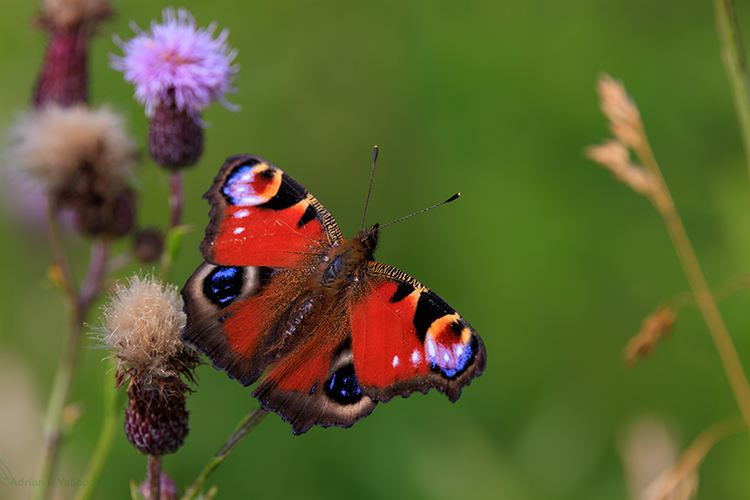
Aglais io:  Peacock

Another lovely 'fresh from the pupae' example. This beauty flew past me as I stood beside a small stream during one of my numerous futile grey wagtail 'stakeouts'. Fearing I may have forgotten how to use the camera over the past few hours of doing nothing I followed him (deduced from the its size) till he found somewhere to sup a little nectar in the sun.

I took a few and thanked him, he had his proboscis full and couldn’t answer, but I swear he winked in acknowledgement, either that or my unrewarded wagtail stakeouts are driving me slowly mad.

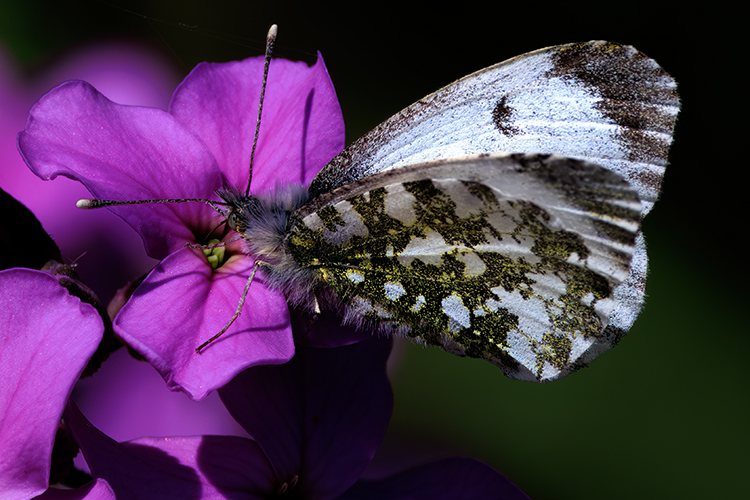
Anthocharis cardamines: Orange tip. Lady in red   green

This was one of my favourites as a kid, being common enough to see around a bit, but not so common you might become blasé. I used to love exploring long-abandoned railway tracks where this species larval foodplants inc: Cuckooflower (Cardamine pratensis) Garlic Mustard (Alliaria petiolata) and Hedge Mustard (Sisymbrium officinale) often abounded. Why not plant some of these in your garden? Just askin’. On my solitary wandering the first sight of fluttering orange in late spring was always a delight. A shorter ‘second brood’ also often occurs in September.

Now I can only witter on for so long before someone asks ‘what bloody orange are you on about?’ Well yes you can see there aint none. The female lacks those bright orange patches so apparent in the male. Indeed, at first sight, you might think she’s a Small White (Pieris rapae) fluttering past, but the first good view of that beautiful green patterned underwing differentiates them.

Of course that lovely underwing isn’t for our delectation, it makes her near invisible when settled on vegetation, something quite handy when there’s tits and the like with hungry young screaming for food back at the nest.

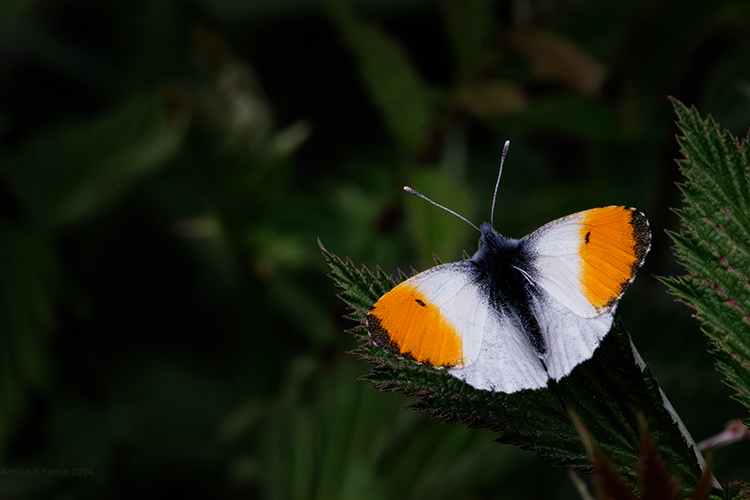
Anthocharis cardamines: Orange tip. The real deal!

As with the Peacock above this fresh beauty flew past me while I waited for the end of the Earth, or for a Grey Wagtail to turn up, whichever came first. That flash of Orange instantly took me back nearly 60 yrs. As I watched he settled on some dark nettles in the sun. He looked glorious, it was a no brainer, go get a picture. So I did.

He asked me if I’d known his great ……………...(repeat 60 times) grandfather who lived in Norfolk, I said I thought I might have done, “Somewhere near Themelthorpe, old railway line” I asked him. “Yes, that would have been him” he replied, and we parted good friends. Or, just maybe, the Grey Wagtail madness was really beginning to take hold, bye bye mind.

ODONATA

Dragonflies and Damselflies can be equally beautiful and, fortunate for the photographer, they often remain in constrained areas. Instead their superpower is high speed, alertness and superb eyesight, they are, after all, aerial predators. Where I live we are not endowed with many species of either, so there are few here at the moment. Fortunately, bird, butterfly and dragon photography require the same kit, so more will hopefully appear.

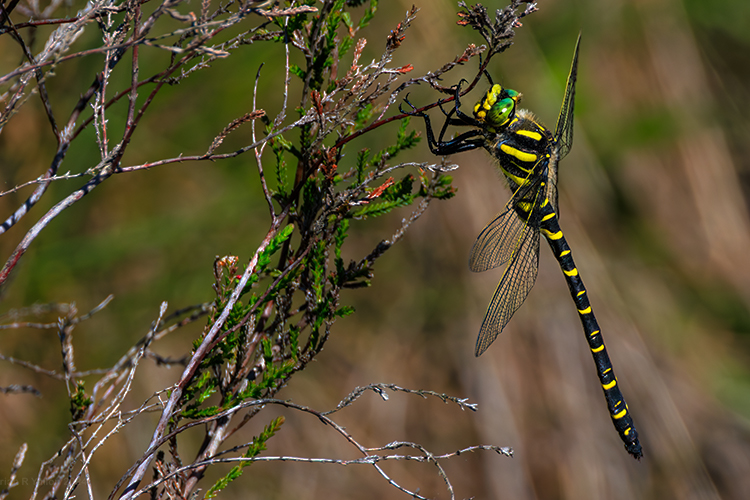
Cordulegaster boltoni  Golden-ringed dragonfly

Big, bold and striking, a lovely sight indeed.

and it isn't just body colour, look at that fine yellow detailing along the front edge of each wing, so let's add 'exquisite' to that description too.

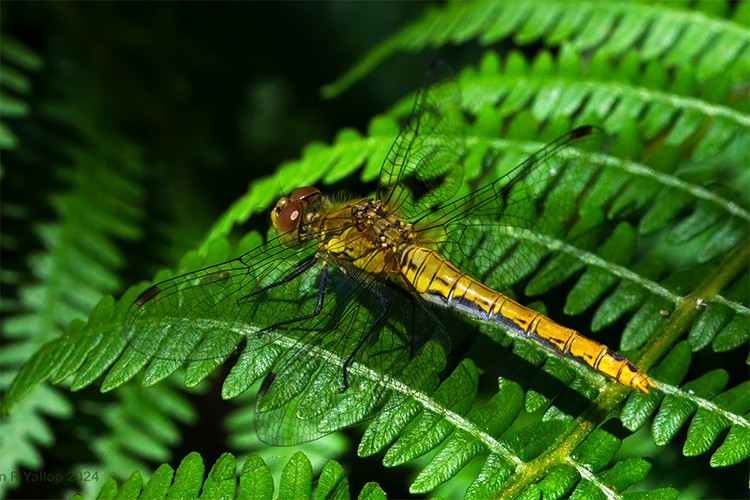
Sympetrum striolatum Common Darter

Common Darter, a glorious and bold red dragonfly. Except, did you notice, this one aint red, she's a lady, and comes in a slightly less colourful yellow. Either way she was darting about, a clue to her name, settling periodically in the same location. I was there for plants, and a 90mm macro is very far from the best lens to try and get imagery of such active and, more importantly, visually acute creatures. They are aerial predators and can spot a tiny insect fly past with ease. A hulking lump like me, bit of a formality I’d say. Well, I had to stalk close, no option with a paltry 1.8x on my side, I decide not to waste my time on her, but her favoured spot. So very time she took off I crept forward slightly, stopping before she reappeared, each time getting slightly closer. It actually worked, and after a bit of this, perhaps 4 days I seem to recall, although it might have been a tad less, I was close enough to get this portrait. After-all that, the angle wasn’t quite right, I took a few for insurance then, as I tried to move slowly sideways she was off. And Julie was getting bored, and probably questioning her sanity being with me, so I moved on. You got the insurance picture.

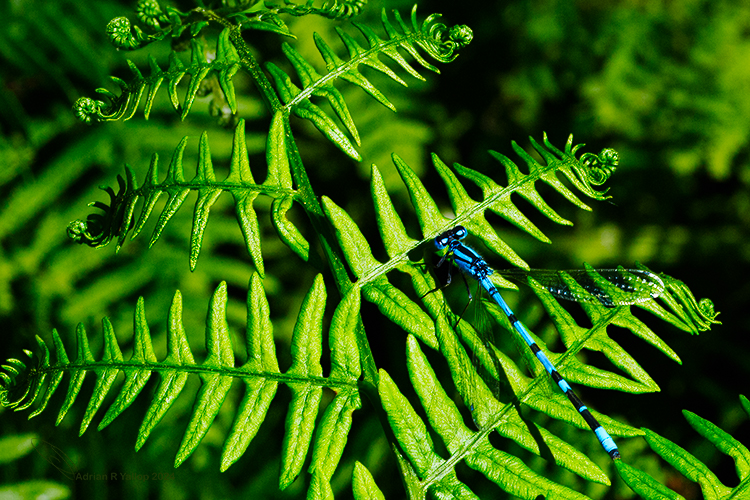
Enallagma cyathigerum   Common blue damselfly

A common enough species, but like all the blue damselflies identification can be tricky, and nigh impossible in flight. Indeed, being small and delicate, usually with translucent wings, and having a rapid darting flight, most of the damsels are often hard to follow on the wing, hence I have no pictures of any Odanata in flight. I have some ideas for doing this, but you’ll have to wait for next summer, or the one after, or the one……..

Anyway, how do I know this one is a cyathigerum or Common blue, well you can just make out the diagnostic ‘mushroom’ shape on the second thoracic segment.

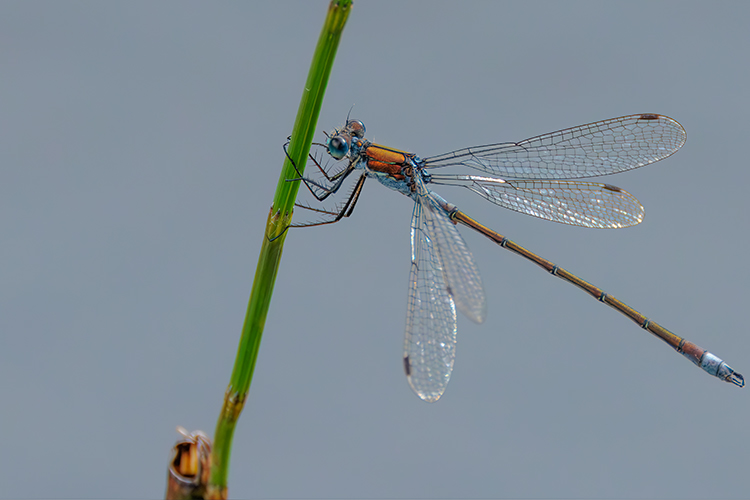
Lestes sponsa   Emerald Damselfly

Another flighty Damsel, land, take-off, dart about, settle again, repeat and repeat. And good luck getting one sitting still long enough to begin to organise getting an image you like. Too far away, half hidden by other vegetation, facing the wrong way, some horrible background, all four, you’ll see a lot of crap possibilities, then when you do find a nice pose through the camera, it’s off ! But it’s a nice day, I have a few hours before I need to get back to sort Julie’s tea. So why not devote them to this lovely damsel (not in distress sadly).

Eventually this chap turns up, lighting ✓, background ✓, clutter ✓ shutter press ✓. And he looks quite quite lovely.

I hear you moan, yet again, “you said it was this the Emerald Damselfly, this one’s brown, what kinda of bullshit are you pulling here?”

Remember those weird cars that changed colour depending on the light angle, rather they always looked sh…. brown unless you twisted your head one way, walked the other, moved up and down, then for the narrowest of angles it would look green, or purple, then turd-brown againes . Perhaps it worked better in California sun, cos in Norfolk rain they looked rubbish. Where was I, oh Emerald damsels.

Well the iridescence that gives many invertebrates their colour depends on the angles of illumination and viewing, and from this angle I clearly got a metallic bronze damselfly ! Very pretty, but no cigar I guess.

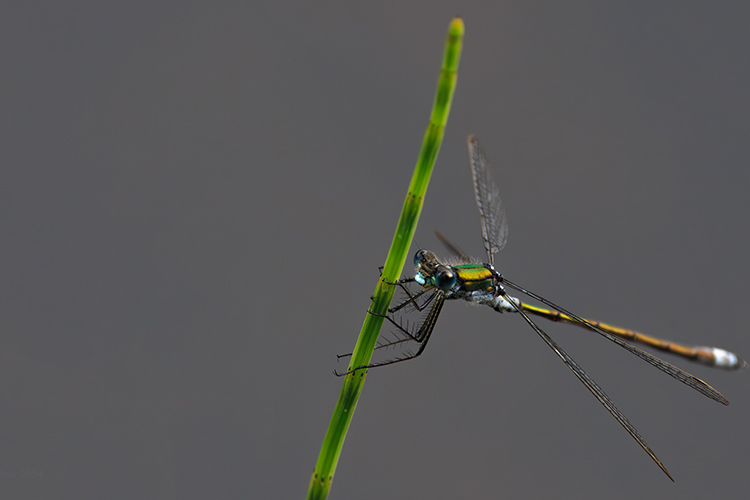
Lestes sponsa

I have more time, so I lurk around for longer, and longer. Finally this chap decides to alight, in the right light (the poet lives) and set nicely against dark shadows from some littoral trees. lighting ✓, background ✓, clutter ✓, EMERALD✓, shutter press ✓✓.

If that isn’t Emerald enough for you, go get your own!

Now, tell me you’ve noticed those luminous ‘lips’ (sure that’s the wrong word of course, but I’ve no idea what a Damselfly’s lips are called). So what is this, well I presume he’s not using a whitening toothpaste that often contain UV brighteners like copper phthalocyanine, but something is causing that and, more importantly, why. I do not know I have to look that up.

Just done that and, well I can't find anything on this topic all. I can imagine, and proabably tell quite convincingly, any number of adaptive stories. No data mind, so I'd have to computer model it, come up with some balls that fitted my story (this is how modern 'science' is done, don't believe any of it).

Lestes sponsa bonking, or not.

Well this may not be the place to discuss such matters, and if you're eating your supper whilst reading this, maybe finish it before carrying on. What is happening here is part of an evolutionary process dubbed 'sperm competition' (and it is a key part of Ecology undergraduate studies I assure you). This is not (yet) a recognised Olympic sport, although they might be a lot less boring if it were.

In many species the last male to mate with a female will fertilise the most eggs. So there is strong competition to be that male. Without getting too puerile most Odonata have attachments like brushes on the end of, not to put too fine a point on it, their genitals. These are for the purpose of removing any previous males sperm (sort of ‘dust and brush up’ I suppose you could say). Hence a 'love 'em and leave 'em ' attitude gets you nowhere in the reproduction stakes. Thus, alongside the 'hoover attachments' the male will grasp the female during egg-laying to ensure nobody else turn up with a brush and dustpan !

Anyway, because knowledge is priceless, there is a lot more about sperm competition you could learn if you wish. Here a couple of books for starters:

Birkhead TR & Møller AP 1992 Sperm Competition in Birds: Evolutionary Causes and Consequences AP.
       ISBN: 9780121005412;
Simmons LW 2021, Sperm Competition and its Evolutionary Consequences in the Insects.
      Princetown University Press ISBN: 9780691059884


Good reading!
COLEOPTERA

Beetles: can't claim I'm a fan. So please don't expect too many, except maybe Ladybirds, they're cute.

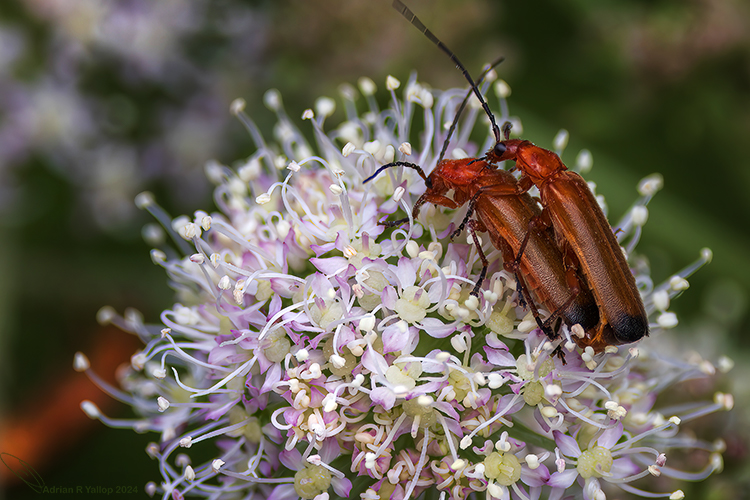
Rhagonycha fulva Common Red Soldier Beetle - bonking

Now I can't claim what they are doing is either pretty or clever, but I suppose it is necessary. Thing is, they’re doing on the side of the road, and that's just rude.

Now apparently they don't just put on sex shows to distract me, as I innocently stroll down the road. Indeed, they're famous for it, they have something of a ‘rep’, as an alternate name for this species is ‘Hogweed Bonking Beetles’, I kid you not. Of course as most Hogweeds, and other umbellifers, are found lining country lanes their lieu de passion is usually a roadside verge. Needs must I suppose.

Now, despite the presumably larger number of visitors this might engender, it is certainly not my intention to turn this site into one dealing in pornographic images. And I am aware this is the second slightly dubious image here (see above), so I will try and hold off from any more.